I interrupt our regularly scheduled blog post intended to cover the 5 Doubles & DARVO to make a book recommendation.
Although the book Nobody's Victim: Fighting Psychos, Stalkers, Pervs, and Trolls was published in 2019, I didn't hear about it until this week on Twitter. And, although it doesn't refer to coercive control or coercively controlling patterns of behavior by name (at least not in the 20% of the book I've read so far)... it sure does a great job of giving real life examples of coercive control.
Coercive control occurs most frequently in domestic abuse, domestic violence, human trafficking and extremist groups (cults), but the pattern of behavior can exist anywhere you can find coercive controllers... which is pretty much everywhere. This book does a fabulous job of revealing patterns of coercive control in contexts you might not expect to find it, as well as within gender-based violence, the most common context.
In my next post I will return to the 5 Doubles and DARVO of the PsychoSocial Quicksand Model™ of Coercive Control.
Stay tuned...
I am honored to have been interviewed by the fabulous therapist and host of the Indoctrination Podcast, Rachel Bernstein! You can listen in HERE.
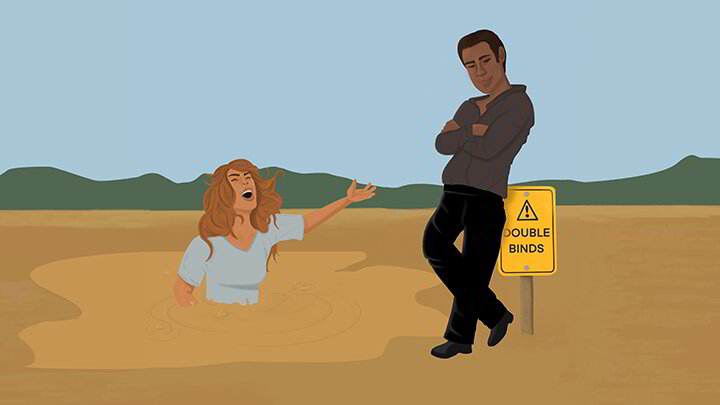
The second Double of the 5 Doubles & DARVO in the PsychoSocial Quicksand Model™ of Coercive Control is #DoubleBinds. #DoubleBinds are fundamental to the trap of coercive control. It is #DoubleBinds that make escape from #PsychoSocialQuicksand nearly impossible for a targeted victim to accomplish on their own. Coercive controllers, therefore, use #DoubleBinds as one of their primary strategies.
What is a #DoubleBind?
A #DoubleBind is a trap masquerading as a choice. On the surface, it appears as though the person has options, but because all options produce negative outcomes, and because the person is required to "choose", it creates a #DoubleBind. (similar to the concepts in Bounded Choice by Janja Lalich).
Coercive controllers are masters of using #DoubleBinds to entrap victims in PsychoSocial Quicksand™. #DoubleBinds increase the coercive controllers chances to win, and that's what matters to them most, WINNING. In order for the coercive controller to win, their targeted victim must lose and #DoubleBinds make that easy (win/win does not exist in the coercive controller's world).
Unfortunately, our systems are also rife with #DoubleBinds, so coercive controllers don't even need to work that hard to ensnare and entrap innocent people in #PsychoSocialQuicksand.
For example, many systems regularly blame victims when a perpetrator causes harm. Child Protective Services (CPS) is well known for this. CPS has policies that shift the blame from the coercive controller to the victim. Within CPS, the most predominant victim-blaming occurs during the day-to-day implementation of their "failure to protect" policy. (To be fair, in some areas, CPS is shifting away from this destructive model and replacing it with what the Safe & Together Institute recommends... #PivotToThePerpetrator).
Failure to protect means that "Parents or caretakers may be charged with a form of criminal or civil penalty called “failure to protect” when they do not prevent another person from abusing the children in their care." Yes, you read that correctly. Someone can be arrested, charged and convicted of a crime that they did not commit, but which they failed to prevent. Or they can have their children taken from them (the most basic of human rights) for failing to stop a coercive control perpetrator from committing a crime (against them) in front of their children.
This policy was put in place to protect children from abuse, a noble outcome objective. However, the policy is badly flawed, not only because it places the blame for the abuse on the wrong person, but also because it opens the door to continued exploitation by coercive controllers and sets up a domino effect of #DoubleBinds.
This is how it works. A coercive controller escalates to physical violence against their partner or ex-partner. The police are called and, hopefully, not the victim, but the coercive controller, is arrested. CPS, in an effort to protect the children, makes an appointment to speak with the adult victim of the assault, the mother of the children. CPS sees that the children have been negatively impacted by what the father has done. Then, in a bizarre shift of responsibility the CPS worker threatens the mother. CPS demands the mother obtain a protective order to keep the coercive controller away from her and the kids. The mother is told that if she does not file for a protective order, they will take her children away for "failing to protect" them from this obviously abusive and dangerous man.
The mother is now highly conflicted. She knows that the coercive controller will escalate his abuse if she does what CPS has demanded. (I call this #SystemicCoerciveControl, because CPS is using a credible threat to coerce and control). This is the first of many #DoubleBinds the mother will likely now face within the system. She will be continuously damned if she does and damned if she doesn't within an upside-down world of conflicting policies, laws and procedures.
Her initial choice between two bad options will result in a bad outcome either way. What should she do? Should she obtain a protective order, knowing her coercive controller may become angry enough to kill her, or should she risk losing custody of her children to the foster care system? What would you do?
Where are the consequences for the person who committed the crime, the coercive controller? CPS doesn't go after him. They focus on the targeted victim, the innocent party, and the criminal is emboldened. The coercive controller is INCENTIVIZED by the system to commit physical violence against his partner, which results in the perfect punishment, not against him, but against HER, one he doesn't even have to carry out himself. This type intimate partner violence has been named coercive violence by researchers, and it is defined as...
"Coercive violence is a form of intimate partner violence in which the abuser intentionally engages in acts that expose his partner to state surveillance and violence at the behest of institutions or the state, including the child welfare system and the criminal legal system."
Many of the #DoubleBinds created and/or exploited by coercive controllers within systems would be considered coercive violence, including the CPS example above.
Let's look further down the road for this victimized mom to see how the dominos of #DoubleBinds will likely fall.
So, she has to choose between a protective order and her children (#DoubleBind number one). Of course, most mothers would choose the children and risk the coercive controller escalating, even if it meant he might kill her. CPS and the county attorney's office have assured her that any protective order violations will be prosecuted, protecting mother and children from any escalation on the part of the coercive controller, so she "chooses" the protective order.
Unfortunately, the police, county and district attorneys and family court have policies that directly conflict with the concept of "failure to protect".
POLICE: "He violated the protective order? Do you have proof?" ME: "Proof? You mean, do I have proof that he tried to run my car off the road? How would you suggest I obtain said proof?"
Multiple police reports for violations of said protective order result in ZERO consequences for the coercive controller, who continues to harass and stalk the targeted victim. (#DoubleBind number 2). However, the targeted victim is still expected to report all violations and appear in court to testify against the coercive controller who continues to stalk her and whom the police refuse to arrest for violations (#DoubleBind number 3). Meanwhile, the coercive controller is playing the "good dad" in family court, and the judge rules that he has a "right" to unsupervised visitation with the very children CPS claimed he was too dangerous to be around.. and let's not forget, now that the mother has divorced the coercive controller (because society claimed it was easy to do) she won't be there to even attempt to "protect" them (#DoubleBind number 4).
In a cruel twist of #SystemicCoerciveControl, the family court judge admonishes the mother for filing almost 20 protective order violations, and claims she is not credible, because the police didn't arrest him (#DoubleBind number 5).
The final #DoubleBind domino falls when the coercive controller lies in family court and the mother's attorney tells her to stay silent about the abuse or it will be held against her in court. With her truth silenced, and attorney advice preventing her from revealing the #SystemicCoerciveControl she has endured for years, she is horrified when the coercive controller obtains full custody and decision-making for the very children she "failed to protect" from him (#DoubleBind number 6).
These are just a few of the #DoubleBinds I personally faced in the system. One day I will write out the whole story, but suffice it to say, there were many many more.
How are coercive controllers so easily able to manipulate and exploit systems to their advantage using #DoubleBinds?
People and systems are able to justify perpetrating these incredibly harmful #DoubleBinds against targeted victims because of the third Double in the #PsychoSocialQuicksand Model™, #DoubleThink. I will cover #DoubleThink in my next blog post.
Stay tuned...
I was researching to compose a blog about how coercive control harms children when I came across Dr. Emma Katz' newest Substack article entitled "The Myth That Coercive and Controlling Domestic Abusers Can Be Adequate Parents". So, rather than writing my own blog, which would have derived a huge amount of its research foundation from Dr. Katz anyway, I defer to the world's leading international expert on coercive control and how it harms children and their relationships. Enjoy!
As mentioned in my previous post, the term coercive control was coined in 1982 by Susan Schecter, and popularized by Evan Stark in his ground-breaking book Coercive Control: How Men Entrap Women in Personal Life, where he recommended it as a new framework, or lens, through which to view domestic abuse. However, research on coercive control began long before Schecter coined the term or Stark developed it into a framework.
In the 1950s, thirty years before Schecter about fifty years before Stark, researchers were already studying coercive control, they just weren't calling it coercive control at the time. Terms like brainwashing, thought reform, thought control, undue influence, and coercion have led to our current understanding of how coercive control functions as a pattern of behavior used by one person to dominate another.
Brainwashing isn't used much anymore, because it implies that a person's mind can be completely taken over by another. Ethical research standards today would make it difficult, if not impossible, to study this possibility, so more nuanced terms like undue influence and coercive control have replaced it. The truth is, a complete takeover of another's mind is not necessary to cause extreme harm to an individual, their well-being and their relationships. Exploitation and trauma can occur using very subtle means of coercion and control and the erosion of a person's autonomy and identity can occur very slowly over time using barely perceptible, even imperceptible, means.
The PsychoSocial Quicksand Model™ of Coercive Control is a synthesis of research and theory on the above terms, as well as influence, neuro-magic, mind control, and presuasion into an easy to understand visual, metaphorical model, using alliteration (The 5 Doubles & DARVO) to train professionals on how coercive control works, and how to detect it. The metaphor of quicksand provides the learner with a visceral and visual reference for how coercive control feels to a person when a strategic campaign of psychological and social tactics are used by a coercive controller to entrap them.
The PsychoSocial Quicksand Model™ of Coercive Control is made up of The 5 Doubles & DARVO: #DoubleStandards, #DoubleBinds, #DoubleSpeak, #DoubleThink, #DoubleVision and #DARVO. The alliteration of the 5 Doubles and #DARVO encompass the tactics and strategies of undue influence, persuasion, coercion, pre-suasion etc, making them easy to remember, and illuminating previously invisible coercive control so that it becomes visible.
Beginning with #DoubleStandards, let's look at the definition and purpose of this type of tactic, and then explore some examples.
What is a #DoubleStandard? #DoubleStandards are rules, rights or privileges that are unfairly applied to different people in different ways. For example, men in a patriarchal society, tend to be provided more privileges than women. Therefore, a male coercive controller can avail himself of these advantages when dominating a female with his coercive and controlling behavior much more easily than a woman could dominate a man (this does not mean that women cannot be coercive controllers, it is just much more difficult for them to do so, because they don't have direct access to male privilege).
#DoubleStandards can be overt, or they can be much more subtle and covert. Overt #DoubleStandards are often obvious in domestic abuse within a heterosexual "relationship" (I put relationship in quotes when discussing coercive control, because if coercive control is present as a pattern, then it's not a relationship built on love and trust it's a fraud built on exploitation and control).
Evan Stark, for instance, views inequality between the sexes as the primary way coercive control functions within domestic abuse by an intimate partner. In his coercive control framework, the most well-known worldwide, coercive control is defined as "an ongoing and gender-specific pattern of coercive and controlling behaviors that cause a range of harms."
Gender norms within society make it easier for a coercive controller to hide his #DoubleStandards in plain sight, while escaping accountability and exploiting his female partner. I consider this use of #DoubleStandards to be overt. By overt I mean that if you examine gendered #DoubleStandards directly the inequality becomes obvious. However, if you have beliefs and biases that prevent unbaised observation, they may still be invisible. If you subscribe to gender norms, these #DoubleStandards will seem "normal" or "just the way men and women are". If you look at them objectively, however, these overt #DoubleStandards can be revealed.
Examples of gendered overt #DoubleStandards that exploit females can include: housework, cooking, cleaning, childcare, emotional labor etc. On the flip side, the privileges of #DoubleStandards for men can look like: making the important decisions, more leisure activities, final authority, not being accountable to anyone for bad behavior, dominating disagreements, never being required to apologize etc. These #DoubleStandards can be perpetuated within religions that proclaim that women must "submit" to their husbands and anywhere else that male power dominates (although this is changing, males still dominate pretty much everywhere).
If your husband insists that you do all (or most) the cooking, cleaning and childcare, because you are "the woman", while he gets to sit on his butt watching football all weekend because he is "the man"... that is an overt #DoubleStandard. His buddies may think it's perfectly normal for you to wait on your husband and his friends hand and foot, but that's not because it's fair, it's because society has subtle patriarchal messages than make (some) males feel justified and entitled to women's unpaid labor for their benefit.
The person being exploited by these #DoubleStandards will often start to see how unfair this arrangement is, and they may begin to call out the coercive controller and demand more equal treatment. As women have gained more equality, it has become more difficult for male coercive controllers to use overt #DoubleStandards to exploit women and girls. And eventually, most women being exploited in these ways refuse to tolerate the unfair treatment any longer.
At this point, if you are with a non-abusive man, he might be willing to work out a more equitable arrangement. However, if you are with a coercive controller, he may escalate to more aggressive forms of coercive control, like physical violence, or he may choose instead to adjust to covert #DoubleStandards, which can be much more insidious and difficult to detect. (It's also possible that the coercive controller will do both, for example, by violently attacking the target, and then claiming it was she that was somehow at fault for his attack).
Covert #DoubleStandards often include something called a false equivalency.
"A false equivalency is an informal fallacy in which an equivalence is drawn between two subjects based on flawed or false reasoning".... AKA... comparing "apples and oranges". The more covert a coercive controller (or the more aware the target is of abusive tactics) the more likely it is that they will use a false equivalence to enforce their #DoubleStandards, rather than being directly unfair. False equivalencies are just as unfair as overt #DoubleStandards, they are just harder to detect, because they involve manipulation and/or deception, so they can often do more damage.
For instance, a male coercive controller may try to convince his female target that his use of the family car to drive to golf games, bowling league and guy's nights out is fair, because she "uses the car all the time". But if we examine the full context, what the coercive controller is obscuring is the fact that the woman's use of the car is exclusively driving children to and from school, getting groceries, and running errands for the entire household. She DOES drive more than he does, but her driving is focused on everyone else and his is focused only on himself, and therefore, this comparison is a false equivalency.
If a conflict arises when she wants the car to go to the salon to have her hair and nails done, when he wants to go play golf, the coercive controller will claim it's "unfair", because she has had the car all week long, and he had to miss his bowling game this week (when she drove the kids to attend an event they were participating in at school). A really savvy coercive controller can use false equivalencies like this one to manipulate their target into giving up their rights and autonomy over time, by causing them to feel guilty for having "unfair" expectations for exercising perfectly reasonable human rights to make decisions in their lives.
The #DoubleStandards that include false equivalencies can also go hand-in-hand with a covert coercive controller's favorite tactic to escape accountability, plausible deniability. Simply put, Plausible Deniability is the ability for a manipulative person to excuse everything they do by questioning the validity of the evidence presented.
"Plausible deniability is what makes us look the other way, give this person another chance, give the benefit of the doubt. With just enough plausible deniability in a story, a narcissist (coercive controller) can get away with murder while holding the bloody knife!"
Let's take a look at how a coercive controller can use false equivalency and plausible deniability together to gaslight the target into a state of disoriented confusion or cognitive dissonance where the target may even take responsibility for the coercive controller's harmful behaviors, without understanding that their autonomy and identity are being eroded.
Back to our previous example of the family vehicle. Let's add another element. So, the coercive controller tells the target that she cannot use the car to go to the salon, because it isn't "fair" that she always uses the car. He guilts the target into giving up her infrequent trip to the salon, and the coercive controller is free to attend his "golf game".
However, he has no intention of going to the golf course. He is having an affair. After guilting his partner into letting him have the car, he proceeds to meet, and have sex with, another woman. His partner knows something is wrong when he returns, because he smells of perfume. She confronts him. He feigns shock at her accusation. He begins to cry and says he can't believe she doesn't "trust" him. Then he offers up the name and phone number of his golf partner for her to call and check, and when she calls, the man confirms her husband was with him the whole time.
What remains invisible, and provides plausible deniability is that the coercive controller carefully arranged the entire previous scenario for the purpose of entrapping his wife in #PsychoSocialQuicksand. He's been telling his friend for months now how controlling his "nagging" and "paranoid" wife is. He has fabricated stories to paint her as abusive and uncaring (by leaving out critical details to the context of the situations), and he has asked him to cover for him if she ever called looking for him. This divisive strategic pattern of coercive control tactics, designed to isolate the target and exacerbate the gaslighting, forges a closer bond with his friend, who now believes his friend is the victim and his friend's wife, the perpetrator.
In the meantime, the wife starts to become the very things he is accusing her of, "nagging" and "paranoid". "Nagging", because her husband is failing to fulfill his responsibilities, and "paranoid" because he is lying to her. Her intuition is telling her something is very wrong, but she can't put her finger on it. The plausible deniability the coercive controller established in advance, makes her gut feelings that he is being unfaithful appear unreasonable and lacking proof, further entrapping her in #PsychoSocial Quicksand.
As the coercive controller uses this and other coercive control tactics over time, his partner's cognitive dissonance will inevitably worsen, and she will likely begin to show signs of mental and emotional distress, making it easier and easier for her coercive controller to exploit her in the future. The more paranoid and controlling she appears, the easier it is for him to recruit supporters to abuse her by proxy. Many of these people won't even know they are enabling the coercive controller's abuse, because, just like his friend, they have been convinced (presuaded) in advance that SHE is the problem, and they will voraciously defend him and attack her (ex. the way Depp fans attacked Heard during the "defamation" case).
Have you experienced #DoubleStandards yourself? Please feel free to leave an anonymous comment.
In my next post I will discuss the next double of the #PsychoSocialQuicksand Model™, #DoubleBinds.
Stay tuned...
If you don't work in the domestic violence, cult, human trafficking or domestic abuse fields, you may not have even heard of the term coercive control. But even if you have, unless you have taken it upon yourself to get educated on coercive control, you probably don't know what it is or why it matters. (Of course, if you have survived coercive control, you probably understand it on a deep level).
The term coercive control was coined in 1982 by Susan Schecter, and popularized by Evan Stark in his ground-breaking book Coercive Control: How Men Entrap Women in Personal Life. Stark introduced the framework of coercive control as a way to more fully, and accurately, understand domestic violence. When I spoke for the Conference on Crimes Against Women, The International Cultic Studies Association Conference and the Domestic Violence Symposium in 2021, I referred to Stark's coercive control framework as a new lens through which our systems could transform to better serve those harmed by coercive control and domestic abuse, if applied properly and systemically.
Whether you view coercive control as a new lens, a new perspective or a new paradigm, naming the pattern of behavior that traumatizes those victimized by it, provides an opportunity for addressing it. Without a name, social issues cannot be addressed.
So, what is coercive control? In the years I have been studying coercive control I have heard many different definitions. My favorite is one by Evan Stark.
"Coercive control is the perpetrator establishing in the mind of the victim the price of her resistance". (I use the word target instead of victim, but victim is the word Stark uses).
This definition of coercive control really cuts to the heart of the matter. In one short sentence we learn:
This definition beautifully portrays the trap of coercive control. Along with the visual images of The Quicksand Model™, we can envision the terror that coercive control creates for the target.
However, what this particular definition of coercive control leaves out is HOW. How does the coercive controller use coercive control to establish in the mind of the victim the price of her resistance?
Here's another definition that I feel answers the HOW question well.
Coercive control is the pattern of behavior that uses force, fraud or fear to control and dominate a person or persons.
This is one of my working definitions of coercive control. The Oxford dictionary refers to "force, threats or causing fear" in its definition, but I feel like threats cause fear, so I took threats out. Also, their definition doesn't include fraud, which I heard referenced in a wonderful episode of the Indoctrination Podcast on consent.
In that episode Joyce Short referred to coercive control as an ongoing pattern of consent violations. I thought that was a great way to look at it. So, when she said that consent is violated anytime there is force, fraud or fear, I incorporated fraud into my working definition of coercive control. (I am also partial to alliteration, so I like the three Fs).
Because coercive control often happens within intimate relationships, I would also like to point out what coercive control is NOT. Coercive control is NOT love! It may masquerade as love, especially in the beginning when manipulative kindness is common, but it is not love. (This is why I don't use the more well-known name for this tactic, "love bombing"). Coercive control is the opposite of love, because its goals are control, domination, destruction and annihilation of the "other", and harming others in these ways is never about love.
Coercive control is a complex and nuanced pattern of behavior, and not all that easy to recognize, detect or pin down. In my next blog I will discuss the first Double of The Quicksand Model™ of Coercive Control... #DoubleStandards. #DoubleStandards are one of 7 strategic tactics in the model for violating a person's consent and establishing a pattern of coercive control that entraps the victim in the quicksand of coercive control.
Stay tuned...
Boundaries are necessary for healthy relationships and mental and physical well-being. But that which makes a healthy relationship thrive can be dangerous or even lethal for the target of coercive control.
Boundaries are impossible to set and maintain in relationships with coercive controllers, because they fly in the face of the main goal of coercive control... complete domination. When one person in a "relationship" wants complete control over the other, that person's needs and wants are considered irrelevant. Since boundaries protect us by making our needs and wants known, a coercive controller will do everything in their power to ignore, ridicule and violate our boundaries.
This may begin slowly or suddenly. For many survivors they noted a distinct change in their partner's ability to hear and respect their boundaries at times that signified commitment. For instance, moving in together, getting engaged, getting married, or having a baby together can heighten a coercive controllers desire to dominate their partner.
Victims, targets and survivors of coercive control are often blamed for not setting better boundaries with their abusive partners. There is still a societal assumption that we teach others how to treat us, and if the survivor would set better boundaries, the coercive controller wouldn't take advantage of them. The problem with this myth is that it is partially true. In some circumstances we do teach others how to treat us. At work, for instance, failing to set good boundaries with our boss can result in being overburdened with work.
However, when it comes to coercive control, boundaries do not work. Why? Because boundaries are exactly what the coercive controller is working to tear down. Coercive controllers HATE boundaries. They may set boundaries for themselves, and DEMAND that everyone around them follow them, but they have #doublestandards for their targets. Other people are not allowed to have boundaries. Spouses, and often children, are viewed as property, not people with their own individual rights and needs. I mean have you ever heard a car talk back to their owner for painting them another color? That's how coercive controllers see other people, as objects that exist purely for their own gratification. They expect their partner to obey them the same way you would expect your car to except a new color of paint.
This is why coercive control often escalates when a survivor sets a boundary. Attempting to make decisions with their own money, wearing what they want, or, God forbid, attempting to divorce a coercive controller can literally be fatal. The most dangerous time for a survivor is when she tries to leave her coercive controller.
And then, the #doublebind... when we blame the victim for setting boundaries. "Why can't you just give him what he wants?" "He is the head of the household. You need to do as he says". "
Please stop #BlamingVictims for not setting boundaries. It may be exactly what has kept them alive thus far.
Coercive control causes trauma, and the degree to which that trauma impacts a target of coercive control is in direct proportion to the degree and duration of the coercive control used to entrap them.
I am a lifelong survivor of coercive control. Beginning just before birth, my father forced my mother to abandon her plan to give birth to me at home, and comply with his demand she give birth in an army hospital, resulting in trauma from day one!
Coercive control is not "witnessed" by children, it is experienced. Whether they are the direct target of the coercive control or not, they absorb the terror-producing messages a coercive controller presents overtly and covertly to them and their family members every day.
So I learned, as many children living with coercive controllers do, that the world was not safe. I learned that love was conditional and that if my father was upset about something, he was going to make it my fault, and punishments would inevitably follow.
These messages caused trauma. They impacted the way my brain developed. They influenced the ways in which my genes expressed themselves, and the way my body responded to stress. They caused nearly irreparable harm... not just because of my childhood, but also because these lessons set me up to be a target for other predators in the future.
Such is often the fate of children forced into contact with coercive controllers, and the reason why I now dedicate my life to raising awareness and to the detection & prevention of coercive control.
While PTSD, CPTSD, anxiety, depression, suicidal ideation are often the result of being targeted by a coercive controller, these trauma symptoms do not need to run our lives, for the rest of our lives. If you've been targeted by coercive control, either in your home, your place of business, within a high control group or some other environment, there is hope for healing.
Don't get me wrong, it's probably not going to be easy, but there is HOPE.
Here are some of the things I have used to calm my nervous system and heal the trauma caused by coercively controlling abuse. Not everything works for everybody, and not everything I tried worked for me, take what works for you and leave the rest. (I do not receive any type of compensation for referring these products or services. I recommend them based purely on my own positive experience with them).
IF ANY OF THE FOLLOWING SUGGESTIONS INCREASE YOUR SYMPTOMS STOP DOING THEM & SEEK PROFESSIONAL ASSISTANCE
Some healing modalities have been more helpful than others. Here are some of my favorites:
1. Sleep - If you have been subjected to coercive control it is likely that you have been deprived of sleep, either as a direct result of your coercive controller preventing you from sleeping, or because your nervous system has been re-wired to prioritize safety... making restorative sleep difficult. If you are looking for somewhere to start healing and you want the easiest and most impactful way to do it... I recommend implementing any and all strategies you can to improve your sleep.
2. Tapping - Emotional Freedom Technique. Tapping, also called EFT, has been shown to reduce stress and anxiety by 41% in under 10 minutes. You can find free tapping videos on YouTube and lots of web sites. If you want an app you can use to track your tapping and have instant access to lots of options, you can try The Tapping Solution. That's the one I use.
3. Unconditional Love & Support - We can only heal once we are safe, and in a supportive environment. That means the more you can surround yourself with supportive and loving people, who empower you to grow and heal, the more quickly you can regain what was taken from you by the coercive controller. Friends, family, support groups, and therapists specifically trained in coercive control or domestic violence are great options. A therapist who understands coercive control can help you understand what happened to you and heal while assisting you to avoid coercive controllers in the future.
4. Living Recovery Program - By Dr. Sandra Brown. This program is designed specifically for women who have been impacted by coercive controllers who also have personality disorders. It is a year-long program that is gentle enough for survivors healing from the aftermath of coercive control and it is self-led. The program is very economical ($33/month). If you cannot afford a therapist, in my opinion, this is the next best thing.
5. Mindfulness Mind Fitness Training (MMFT) - Another option for self-led healing is Elizabeth Stanley's MMFT program. This program is 8 weeks long. However, it is flexible enough to be stretched out for longer. This program includes lots of safe exercises for trauma survivors to heal their nervous systems to feel safer and more grounded. Meditation is often sought out and recommended for healing trauma. However, the trauma of coercive control often creates Complex Post Traumatic Stress, and meditation can be harmful if used too soon. The MMFT program eases participants into exercises safely, so as to prevent further harm.
6. Healthy Food - I know it sounds cliche, but you literally are "what you eat". To heal your nervous system from trauma, you need to nourish your body with foods that will support that healing.
7. Exercise - There are many different types of exercise, and all of them are good for healing trauma at different times depending on your goals.
- HIIT: has been found to reduce oxidative stress, anxiety and neuronal damage.
- Walking releases endorphins, stimulates relaxation, improves mood and can reduce the severity of PTSD symptoms.
- Aerobic Exercise is especially good for restoring health.
- Weight Training is beneficial for strengthening mental health and overcoming PTSD.
Whatever form of exercise you choose can assist you in your healing journey from coercive control. I like to mix things up and get all of these types into my weekly schedule. Here is the link to the Max T-3 Program I follow most days.
8. Stellate Ganglion Block: This is a relatively new and innovative treatment for PTSD and CPTSD. I have had success myself with this treatment and have two survivor friends who have as well. There are risks though, so it's very important to get all the information before making a decision to have the procedure done.
9. Meditation: As mentioned above, meditation can be a viable treatment for trauma. However, it also comes with potential risks, especially for those harmed by coercive control. If you try meditation and it increases your symptoms, you may want to start with MMFT instead.
10. Psycho-Education: Perhaps one of the most validating for the person harmed by coercive control is psycho-education. When we read books, articles etc. on trauma, coercive control, domestic abuse, neuroscience etc. we quickly learn that what was done to us was not our fault. The coercive controller is 100% responsible for the trauma caused by their coercive and controlling behaviors. Psycho-education can help widen our perspective and re-discover ourselves beyond the influence of the coercive controller.
11. Breathing Techniques: This is another healing modality that persons harmed by coercive control might want to approach with caution. The one I have found most helpful, and least triggering, is the 4-7-8 Breathing Technique. If you try breathing exercises and find they worsen your symptoms, I recommend you try MMFT or EFT first to establish a feeling of safety in your body before advancing to breathing techniques.
Click for more resources and research on coercive control and healing.
What healing tools have you used to overcome the trauma and aftermath of coercive control? Please leave a comment below.
Have you heard the term victim blaming? You probably have, but let's talk about it anyway, because you may not be aware of one of the more subtle versions of victim blaming and the ways that victims can be additionally harmed by this gaslighting method.
Victim blaming occurs when a negative, harmful behavior or crime is blamed on the person who was victimized rather than the person who perpetrated the harm. Victim blaming, although common, becomes absurd if you rationally think about it.
Let's take for example a bank robber has robbed a bank, and police are questioning the bank manager. If police choose to victim blame, in this example, they might say to the bank manager something like "Why did you tempt this man by keeping so much money here?" Or, how about a case involving a hit and run. Should police ask the person crossing the street "Why didn't you jump out of the way of that oncoming car that drove up onto the sidewalk?" or "Why were you walking down the street at this hour?"
Absurd, right?
But, when it comes to crimes that are often gender-based, like domestic violence, sexual assault and coercive control (not that they are always gender specific, but they are predominantly crimes against women and girls) that is exactly what police, attorneys, judges and society frequently do, they blame the victim. They ask "well, what were you wearing?" (sub-text: that caused him to rape you). Or, "Isn't it true that you just hate all men? (sub-text: causing you to misread the situation).
Rape, sexual assault, domestic violence, domestic abuse, coercive control etc. are no more caused by the victim than other crimes are. This is a harmful and dangerous myth that protects coercive controllers and further traumatizes victims. It is rooted in patriarchy and misogyny, and it needs to stop.
Furthermore, victim blaming is at the heart of the pattern of coercive control, making it one of the coercive controller's greatest weapons. Victim blaming is also foundational to the coercive and controlling strategy of DARVO, where the coercive controller will deny their own bad behavior, attack their victim, (often using irrelevant and/or completely false allegations), and reverse the roles victim and offender in order to gain, maintain and/or increase control over their victim. Victim blaming is what enables coercive controllers to continue to harm their victims without being held accountable.
In coercive controlling "relationships" victim blaming often starts subtly and gradually, becoming more frequent over time, to keep the victim from realizing that the coercive controller is harming them, usually on purpose. Victims are taught through repetition to question their own reality and take responsibility for the coercive controller's actions. For example, if the victim discovers their spouse has been cheating on them and confronts the coercive controller, he/she is likely to turn the tables by questioning the targeted victim's loyalty. "Don't you trust me? Why don't you trust me? How do you expect us to have a strong healthy relationship if you don't trust me?" This strategy causes the victim to blame themselves and look inside to try and fix a problem that can only be fixed by the person responsible, the coercive controller.
Over time this constant victim blaming can erode the victim's entire sense of self and reality, trapping them in PsychoSocial Quicksand™. Many victims of this type of gaslighting become anxious, depressed, and even suicidal. Some even develop full blow Complex Post Traumatic Stress, which can be debilitating.
If there is a single strategy that frequently allows coercive controllers to continue their harmful behavior unimpeded, it is victim blaming. And it is imperative that we remove victim blaming from our communities, groups, religious organizations and systems if we ever hope to reduce domestic abuse and coercive control.
There are two types of victim blaming: overt victim blaming and covert victim blaming. Over victim blaming looks like telling a rape victim she was raped because she was wearing a short skirt, or drunk, or walking in a dark alleyway. Covert victim blaming is more subtle. One place I commonly find victim blaming that is covert is in a therapeutic or self-help setting, where victims are led to believe that they can prevent their own victimization in some way. They can somehow heal their own shame and childhood wounds, and that by doing so, they will be impenetrable. They will be invulnerable. They will be unstoppable! And they will never be targeted by a coercive controller ever again!
This is a very alluring concept for someone who has been victimized. It was for me. I bought into this "unstoppable" and "invulnerable" belief for decades. I worked and worked and worked on myself and my trauma. I read so many self-help books and attended so many personal development programs that it "transformed" my thinking and pretty much overtook my life. I believed the therapists, gurus, self-help authors and motivational speakers who claimed I would be safe if only I worked on my boundaries, my co-dependence "issues", and my SELF. But guess what? This approach didn't work. Did it make me more successful? Yes, in many ways it did. Did it make me more disciplined and persistent? Yes, it did. Did I gain muscle and lose fat? Yep! Did I learn how to defend myself against an attacker using karate. I did! This approach had many positive benefits. But did it prevent me from being victimized? It absolutely DID NOT!
And I am going to tell you why. Because I was not the problem. And if you have been victimized, You are not the problem either!
Did I have weaknesses and flaws that needed work? Of course I did. I still do. But working on my weaknesses was not the cure for stopping a coercive controller from harming me. Coercive controllers, abusers etc. are 100% responsible for the abuse! Period! Has therapy and self-help study helped me in other ways? Yes, it has. I have become more compassionate with myself and with others. I have improved my focus and prioritized my values. I have learned to be less hard on myself... something that reading every personal development book under the sun had actually made worse. Did it help me to respond more effectively in situations where I was being harmed? Absolutely! But it did not do what it could not do. It did NOT make the abuser stop abusing. It did not prevent me from being targeted by a coercive controller.
This idea that we "attract" things into our lives is only partially true. Yes, being grateful will help us better recognize the things in our lives to be grateful for. Being loving will often attract more love into our lives. This happens for many reasons, one of which is that we have shifted our focus, and see love and gratitude more easily... a kind of placebo affect. The positive benefits of this stuff can be great! It's wonderful to learn that we can shift how we perceive a situation in order to see the positive rather than the negative aspects of it. This shift in perception can make us live happier and more fulfilled lives. But it can also do something else...
It can make us even MORE vulnerable to coercive controllers. How does it do that? The same way a coercive controller uses DARVO as a smokescreen to avoid accountability, intense focus on personal development concepts causes us to look inward and take responsibility for everything we are "attracting" into our lives. This creates a hole in our boundaries big enough to drive a coercively controlling truck through! The "law of attraction", when taken to the extreme, obscures harmful and dangerous behaviors by other people toward us.
NXIVM and Landmark Education Corporation, for instance, teach a concept called "at cause". This is essentially the same idea as the law of attraction... that we create our lives, and that we are 100% responsible for whatever shows up. This concept, strongly internalized by intelligent, successful and powerful women in NXIVM was precisely what allowed Keith Raniere to exploit those women for his own sexual gratification and personal gain. Not only did he deeply harm them using this concept as a trap, but he even made some of them believe that the horrific abuse was an "honor" and a "privilege". You can bet they don't feel that way now that they know the truth! Coercive controllers deceive, and victim blaming makes deception much easier.
It is true that some people are more vulnerable than others to coercive controllers. But it is NOT true that some people are not vulnerable at all. Human beings are vulnerable due to our normal human psychology and basic biological and physiological needs. Coercive controllers exploit our humanity, they exploit our need for connection, for love, for accomplishment, for stability. Coercive controllers exploit whatever they can to keep us compliant and under their control.
I understand the need to believe in a secret weapon that will protect you from abusers, but I am sorry to say that this does not exist. Not in the real world. There is always something a savvy coercive controller can use to torture and terrorize you. If you think I am wrong, let me ask you this. Do you love your children? If a coercive controller were using the threat of harm, or even death, of your children against you, would you be invulnerable? OK, so maybe you don't have kids... what about your friends, your parents, your significant other? What if the coercive controller were threatening their lives? What if they were demanding something from you... or else!?!?! This ambiguous threat can be really terrifying. I assure you that there is something in your life that the loss of that thing could terrify you... potentially terrify you enough that you might comply with something you would never even consider under other circumstances.
Coercive controllers are terrorists! They may use more subtle or covert means than by holding a gun to your head, but if a coercive controller targets you, therapy won't protect you... not completely. It may help you deal with the aftermath. It may help you develop healthier coping skills and ways of relating to the abuse, but it cannot stop the abuser. Setting boundaries and working to be less co-dependent may make other areas of your life better, but setting boundaries with a coercive controller will only piss them off! Coercive controllers hate boundaries. They hate acts of resistance. They want you to be who they want you to be, and you will not be permitted to be who you really are around them, not without severe punishment.
The internet is full of coaches, therapists, counselors etc. claiming that they can heal the parts of you that "attracted" the abuser in the first place. Some of them are teaching things that are very helpful. Most of them are genuine in their desire to help. But some of them are predators, coercive controllers exploiting the victim blaming myths in order to exploit victims for their time, money, admiration, etc. Keith Raniere is one such predator. He is serving 120 years in prison. His followers believed their lives were improving and that they would positively impact the world. They weren't vulnerable because they were stupid or naive. They were vulnerable because they are human. Just like YOU!
Therapy and working on yourself are useful and valuable, but as long as you are human, you are like the bank manager with a bank full of money. You may be able to slow down the bank robber or set alarms to catch him, but only the bank robber can stop bank robbing, by deciding they will no longer rob banks.
Coercive control tactics are incredibly effective! The only sure fire way to protect ourselves is to detect, prevent and intervene when we see coercive control. We need to band together. We need to implement #SystemicTransformation where victim blaming is no longer permitted and coercive controllers are held 100% responsible for their behaviors.
We may not be able to prevent 100% of the harm, but the faster we can escape the PsychoSocial Quicksand™ of coercive control, and assist others to escape it, the less damage it can cause.
DARVO is a popular strategy of coercive controllers and an important aspect of the PsychoSocial Quicksand Model™ of Coercive Control.
DARVO stands for Deny, Attack, Reverse Victim & Offender, and coercive controllers use it to get away with their coercive and controlling behaviors, with the added benefit of focusing all of the blame on their targeted victim. The term DARVO was coined by Jennifer Freyd in research, where she found it to be very common, especially, with coercive controllers who had perpetrated sexual assault and used it to deflect attention and avoid consequences. This is what Freyd's web site says about DARVO.
"DARVO stands for Deny, Attack, and Reverse Victim and Offender—a perpetrator strategy. The perpetrator may Deny the behavior, Attack the individual doing the confronting, and Reverse the roles of Victim and Offender, so that the perpetrator adopts the victim role and accuses the true victim of being an offender."
Freyd's site includes a link to a Southpark video that explains DARVO and gives examples (If you don't care for Southpark, or if you support Donald Trump, I don't recommend watching it because it's not very flattering of the former president).
DARVO isn't only utilized by coercive controllers to avoid sexual assault or sexual misconduct allegations. DARVO is also used frequently in family court, not just in the US, but worldwide. Because court policies and practices, especially family court policies and practices, are not designed to protect victims. Criminal courts are designed to punish crimes while protecting citizens from false prosecution, and reasonable doubt is the foundation of our criminal justice process for preventing this. Guilt, in this system, is determined by judging the evidence against "a reasonable doubt". If guilt beyond a reasonable doubt is not established, defendants are set free. One aspect of this is very good. After all we don't want innocent people being sent to prison.
However, when a person has committed a crime, but law enforcement and prosecutors are unable or unwilling to hold them accountable, due to reasonable doubt, the only person who wins is the perpetrator. Although some might argue that society wins because reasonable doubt does a decent job of preventing false prosecution, with certain crimes, especially gender based crimes like domestic violence and sexual assault, this does not appear to be the case. Prosecution of these crimes is almost non-existent it's so low, and domestic violence offenders, in particular, have about a 98% chance of avoiding jail time.
Another aspect of our criminal justice system, at least in the US, is the right of an accused to be represented by an attorney, and if they can't afford an attorney, to be provided one at no cost. This too is important to keep innocent people from going to jail (not that it always does). But this too can reduce the likelihood a true perpetrator will be held accountable.
Additionally, the rules in our current systems were designed to protect those who were privileged at the time the systems were created. That means that there is prejudice and bias baked into the policies and procedures of these systems. Gender bias, economic and racial bias (among others) are woven throughout these systems, and just like coercive control, the bias is invisible in plain sight.
The majority of domestic abuse victims have Post Traumatic Stress Disorder (I prefer "response" to "disorder", but this is the current name in the DSM) from the abuse and/or coercive control they suffered at the hands of their perpetrator. PTSD is a recognized disability covered by the Americans with Disabilities Act (ADA). Although courts are supposed to follow the the ADA, victims are rarely provided with the information they need to avail themselves of these protections. And even when victim/survivors do attempt to use the ADA to protect themselves in court, it can be used against them, potentially making them appear to uneducated judges to be less capable of caring for their children, and further disadvantaging them in family court custody matters.
There are other problems with bias and assumptions in family court. Victims often face bias by uneducated attorneys and judges who blame victims for staying, or for leaving, or for calling the police, or for not calling the police, or for failing to give their child enough love and support (neglect), or for giving their child too much love and support (enmeshment), or for "alienating" the child from his father, or for "failing to protect" a child from his father... the list of double binds that victims face in family court can seem endless, because it practically is!
Then there's the gender credibility gap that women have to overcome when facing a coercive controller in family court. Women are perceived as less credible automatically, and credibility is EVERYTHING in a custody battle when you are trying to protect your children from an abusive ex. If the court believes you are lying, you're done for. Custody decisions will favor the coercive controller. And the chance of this happening increases when the coercive controller claims the victim/survivor has alienated the children, as indicated by Joan Meier's research.
With everything else standing in the way of justice and safety for victim/survivors of coercive control in family court, the final blow is often perpetrated using DARVO. Coercive controllers know that family court is biased in favor of fathers. They know this because the Father's Rights Movement has been operating for decades to gaslight the family court system into the false assumption that 50/50 custody is best for children... even when domestic violence or abuse are factors. This movement, which sounds like a good thing, should be more accurately labelled "Abuser's Rights", rather than Father's Rights, because they primarily operate to shield abusive men from consequences, and to silence and harm victim/parents of coercive control and domestic violence by weaponizing children.
The number one weapon of the father's rights groups is to claim the mother (who has accused the father of domestic violence, child abuse or coercive control) is lying. Not only, do they claim she's lying, but she has also "brainwashed the children" to believe the "lies" and "turned the children against the father".
Here's how DARVO can, and often does, play out in family court:
DENY - the coercive controller claims "I never abused my wife or children. I'm a good dad. I love my children. I would never hurt them."
ATTACK - then the coercive controller exploits the gender bias already present in family court to attack her credibility with something like, "I think she might have a personality disorder.... Borderline... I think it's called... Borderline Personality Disorder. She needs to be evaluated for drug and alcohol use, and another thing... she's crazy."
REVERSE VICTIM & OFFENDER - the coercive controller finishes off the victim/survivor of his (almost always intentional) coercive control by playing the victim and claiming the victim harmed him. "I don't understand why my ex-wife is saying these horrible things about me. I know she was abused by her father. She must have a 'victim-mentality' that is clouding her judgement and making her believe I did something I didn't do. "She must have some kind of mental illness" OR "She's a mean drunk and can't take care of the kids" OR "My children loved me and wanted to be with me until she started claiming I was abusive. I just want to be able to see my children, whom I love dearly. Is that too much to ask?"
DARVO is incredibly effective in family court because coercive controllers exploit the system's vulnerabilities the same way they exploit their targeted victim's vulnerabilities. They use existing bias, bad policies, ignorance of evidence-based research, lack of transparency, lack of accountability for judicial actors, fear, threats and manipulation and more... to WIN. After all, it is the ultimate goal of coercive control to completely dominate the victim, and winning in family court helps the coercive controller do just that.
How can we fight back against this incredible injustice and protect children from dangerous coercive controllers?
We have to do what has been shown to reduce DARVO. We have to point it out. We have to educate the court to the coercively controlling strategy of DARVO, so that when an attorney or a judge sees it playing out, they can call it out... and they can find in favor of the protection for adult and child victims in the case. If you see DARVO, please don't stay silent, believing it is a private matter. Call it out when you see it. DARVO loses it's power when the coercive controller can no longer hide behind this deceptive and manipulative strategy.